


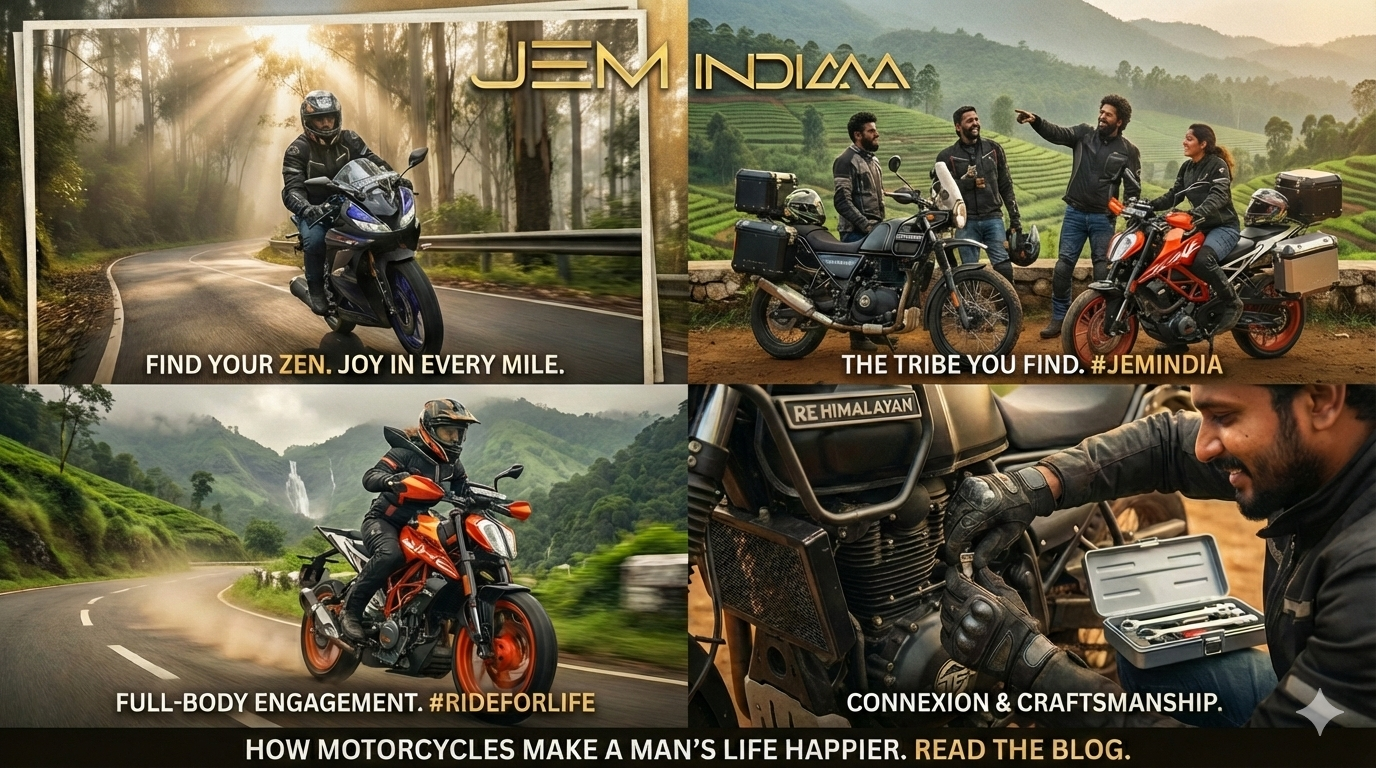
You've probably heard it before. That question with a hint of skepticism: "Why do you need a motorcycle? Isn't it just dangerous and expensive?"
I get it. From the outside, motorcycling looks like an adrenaline-fueled hobby at best, a death wish at worst. But here's what non-riders don't see—the profound, almost inexplicable way that motorcycles change your life for the better. "Not just as a hobby, but as a practice that rewires your mind, strengthens your body, and connects you to something larger than yourself".
There's a reason riders talk about finding Joy in Every Mile (JEM). It's not just a catchy phrase—it's a lived reality. Let me explain what that means.
The Therapy You Didn't Know You Needed
Modern life is loud. Not just in decibels, but in demands. Your phone buzzes with notifications. Your inbox never empties. Your mind runs a constant loop of deadlines, obligations, and what-ifs. You're always on, always accessible, always halfway present.
Then you throw a leg over a motorcycle.
The moment you twist that throttle and lean into the first corner, everything else dissolves. There's no room for your work stress or your argument from last night or your mounting to-do list. There's only you, the machine, the road, and the immediate present. Miss that car merging into your lane? Problem. Overthink that upcoming presentation? You'll end up in a ditch.
Motorcycling demands presence in a way that meditation apps can only dream of. It's forced mindfulness at 60 miles per hour. Your breathing syncs with the engine's rhythm. Your body reads the road through the handlebars. Your vision expands, scanning for hazards, drinking in the landscape. For those hours in the saddle, you're finally, completely here.
And when you park and pull off your helmet? The world feels quieter. Clearer. Problems that seemed insurmountable that morning now feel manageable. That's not escapism—that's perspective. That's JEM at work—finding joy not just in the destination, but in every single mile of the journey.
The Brotherhood You Stumble Into
Here's something they don't tell you: motorcyclists are the most welcoming tribe you'll accidentally join.
It doesn't matter if you're riding a pristine Harley or a beat-up old Honda. Wave at another rider, and they'll wave back. Pull over with a mechanical issue, and someone will stop to help. Join a group ride, and you're instantly part of a community that spans ages, backgrounds, and tax brackets.
There's an unspoken understanding among riders. We've all felt the same fear on our first ride. We've all had that moment where everything clicked. We've all experienced the unique cocktail of vulnerability and freedom that comes with being on two wheels. That shared experience creates bonds faster than years of small talk ever could.
I've met lawyers, construction workers, teachers, and tattoo artists on group rides. We might have nothing else in common, but we've got this. And in an increasingly isolated world, that kind of instant connection is rare and valuable.
The brotherhood isn't just about camaraderie either. It's about accountability. When you ride with others, you ride smarter. You look out for each other. You share knowledge, from the best roads to the best mechanics. You become part of a culture that values skill, respect, and looking after your own. Together, you experience Joy in Every Mile—because the best rides are the ones shared with people who understand.
What It Does to Your Body and Mind
Let's talk physiology for a second, because motorcycling isn't the passive activity it might seem from the outside.
Riding a motorcycle is a full-body workout disguised as fun. Your core muscles engage to stabilize your body through corners. Your arms and shoulders work to control the bars. Your legs grip the tank. Even your neck gets a workout fighting wind resistance. After a long ride, you'll feel it—the good kind of tired that comes from physical engagement, not just sitting in traffic.
But the real magic happens in your brain.
Studies have shown that motorcycling increases adrenaline and endorphins while decreasing cortisol—the stress hormone. You're literally rewiring your brain chemistry for happiness. The concentration required activates your prefrontal cortex, improving focus and cognitive function. The sensory input—wind, sound, vibration—keeps your nervous system engaged and alert.
Over time, regular riders report better stress management, improved mood, and increased mental clarity. It's not just the ride itself; it's the anticipation of the next one. Having something to look forward to, a passion that pulls you out of routine, fundamentally changes your relationship with daily life.
The Mechanical Connection: Working with Your Hands
There's something primal and satisfying about understanding how your machine works. Unlike modern cars—which are essentially computers on wheels—motorcycles remain accessible, mechanical, knowable.
Change your own oil. Adjust your chain. Bleed your brakes. These aren't just maintenance tasks; they're acts of connection. You're learning the language your bike speaks. You're taking responsibility for the machine that takes you places. You're using your hands to create something tangible: reliability, performance, trust.
In an age where most of us work in the abstract—emails, spreadsheets, meetings about meetings—there's profound satisfaction in tightening a bolt and knowing it's done right. In diagnosing a problem and fixing it yourself. In watching a dirty carburetor transform into a clean, functioning component.
This mechanical relationship extends to the ride itself. Unlike driving a car, where you're insulated and automated, riding a motorcycle keeps you in constant conversation with the machine. You feel every imperfection in the road. You manage the clutch, the throttle, the brakes in concert. You're not a passenger in your transportation—you're a participant.
That engagement, that constant feedback loop between human and machine, creates a meditative state. Your thoughts slow down because your hands and body are occupied with the precise, deliberate work of riding well. This is where JEM becomes more than a concept—it's a practice. Every mile ridden with awareness and connection becomes a source of genuine happiness.
The Answer to "What Does It Bring?"
So what does motorcycling bring to your life?
It brings presence in a distracted world. It brings community in an isolated age. It brings physical engagement and mental clarity. It brings the satisfaction of mechanical understanding and the meditation of the open road.
But more than all of that, it brings Joy in Every Mile.
That's what JEM means to those of us who ride. It's not about the bike you own or the miles you've logged. It's about finding happiness in the journey itself—in the twist of the throttle, in the lean through a corner, in the sunrise ride before the world wakes up, in the nod from a passing rider.
Simple, uncomplicated, wind-in-your-face joy.
Not everyone will understand. That's okay. Some things can only be explained by experience. But for those who ask with genuine curiosity, invite them for a ride. Let them feel it for themselves.
Because happiness isn't found in the destination. It's found in every single mile—with two wheels beneath you and the whole world ahead.
Joy in Every Mile. JEM. That's what motorcycling brings.